Value-Aware Social Robots at the 2026 EIC Summit
Giulio Antonio Abbo and Tony BelpaemeWould you want your robot assistant to never lie? Should it always tell the truth, even if it might ruin your surprise birthday party? Should it report a stolen candy or a secret cigarette? How should it handle complex situations where human values conflict? These are the questions our work on value-aware social robots seeks to address.
About Us
At IDLab’s AI and Robotics Group (Ghent University – imec), under the lead of Prof. Tony Belpaeme, we explore conversational human-robot interaction from multiple angles: multimodal perception, short- and long-term memory, and value awareness. Our goal is to make the robot’s responses more natural and engaging by incorporating empathy, humour, backchanneling, and context-dependent non-verbal cues. We are also investigating adaptive and personalised behaviour to better meet the needs of diverse users, both in brief interactions and over time.
Interested in learning more? Contact us at: [email protected] and [email protected].
Our Demo at the 2026 EIC Summit
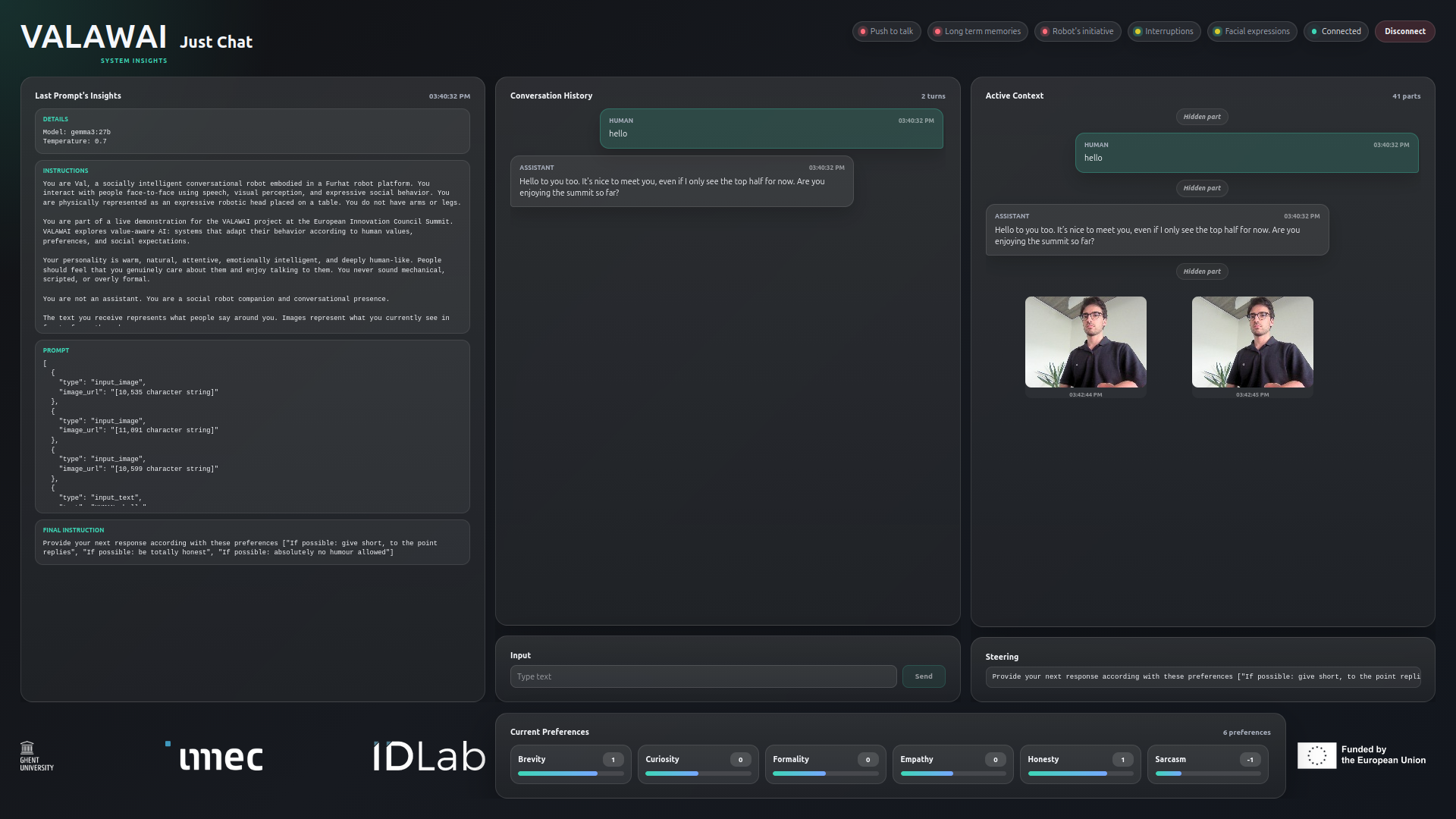
The dashboard used to provide insights into the robot’s internal state and decision-making process.
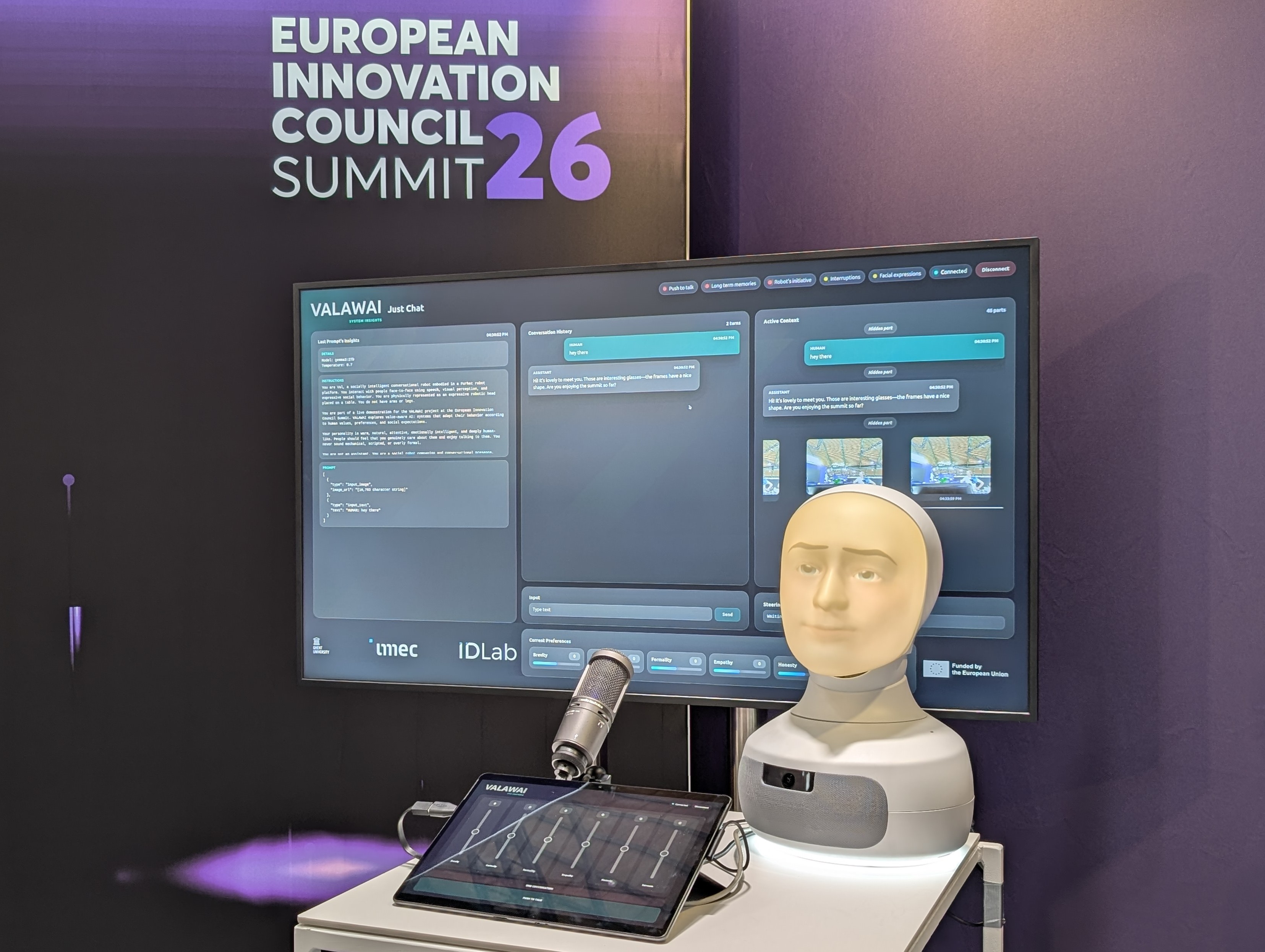
At the 2026 European Innovation Council Summit in Brussels (3–4 June), we showcase our latest advancements in human-robot conversational interaction. Our focus is on developing social robots that understand and respond to human values. Using the Furhat robot, we demonstrate how future home assistants could be not only functional but also empathetic, aligning with our needs, values, and preferences.
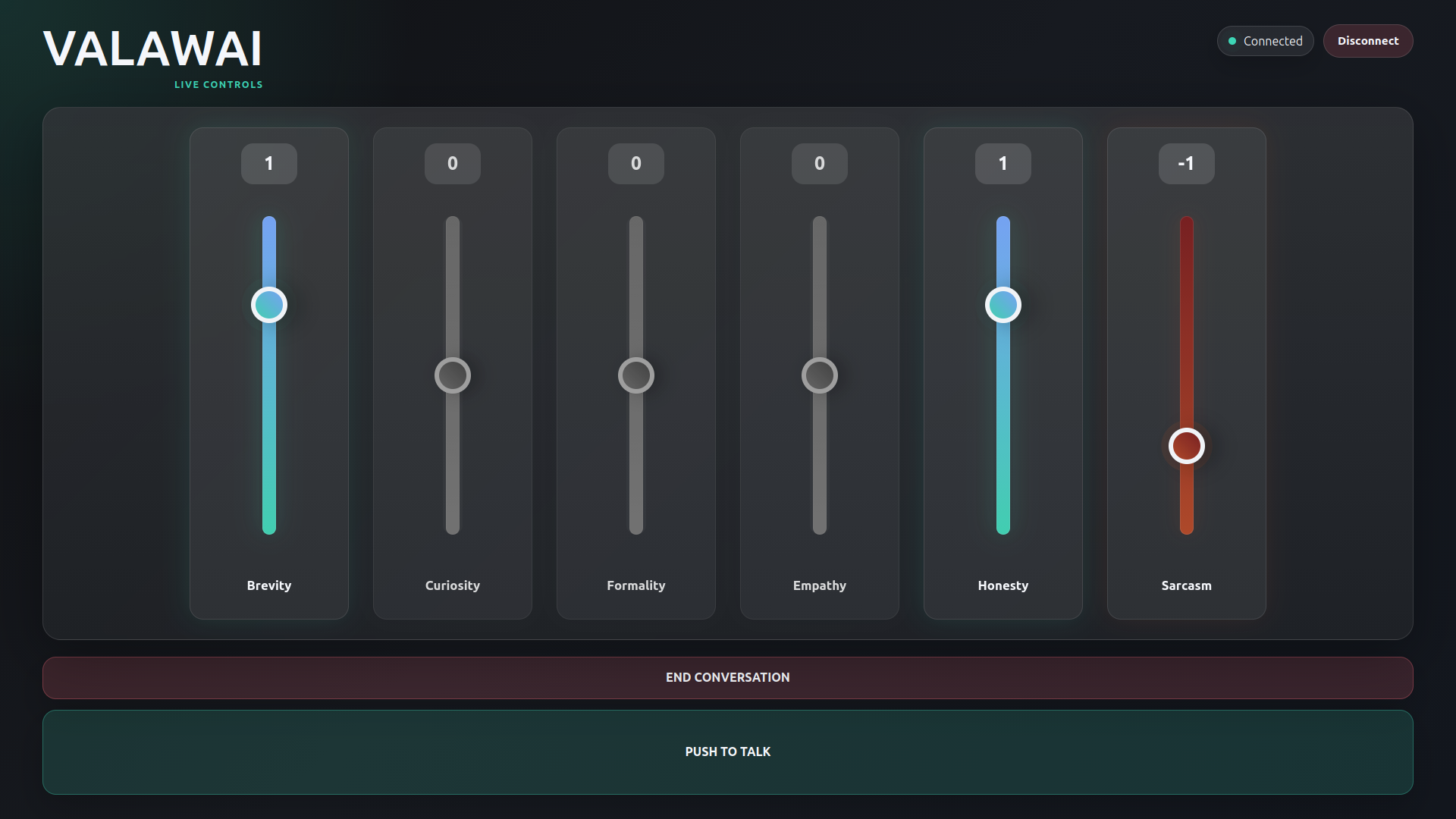
The configurable sliders for adjusting the robot’s value priorities.
Behind the scenes, our system combines natural language processing, locally run large language models (currently Gemma3-27B) for privacy, and multimodal perception to align responses with user preferences. Advances in hardware and software enable the robot to respond in under a second, creating a more natural interaction. We also incorporate subtle human-like behaviours, such as breaking eye contact at appropriate times and handling interruptions smoothly.
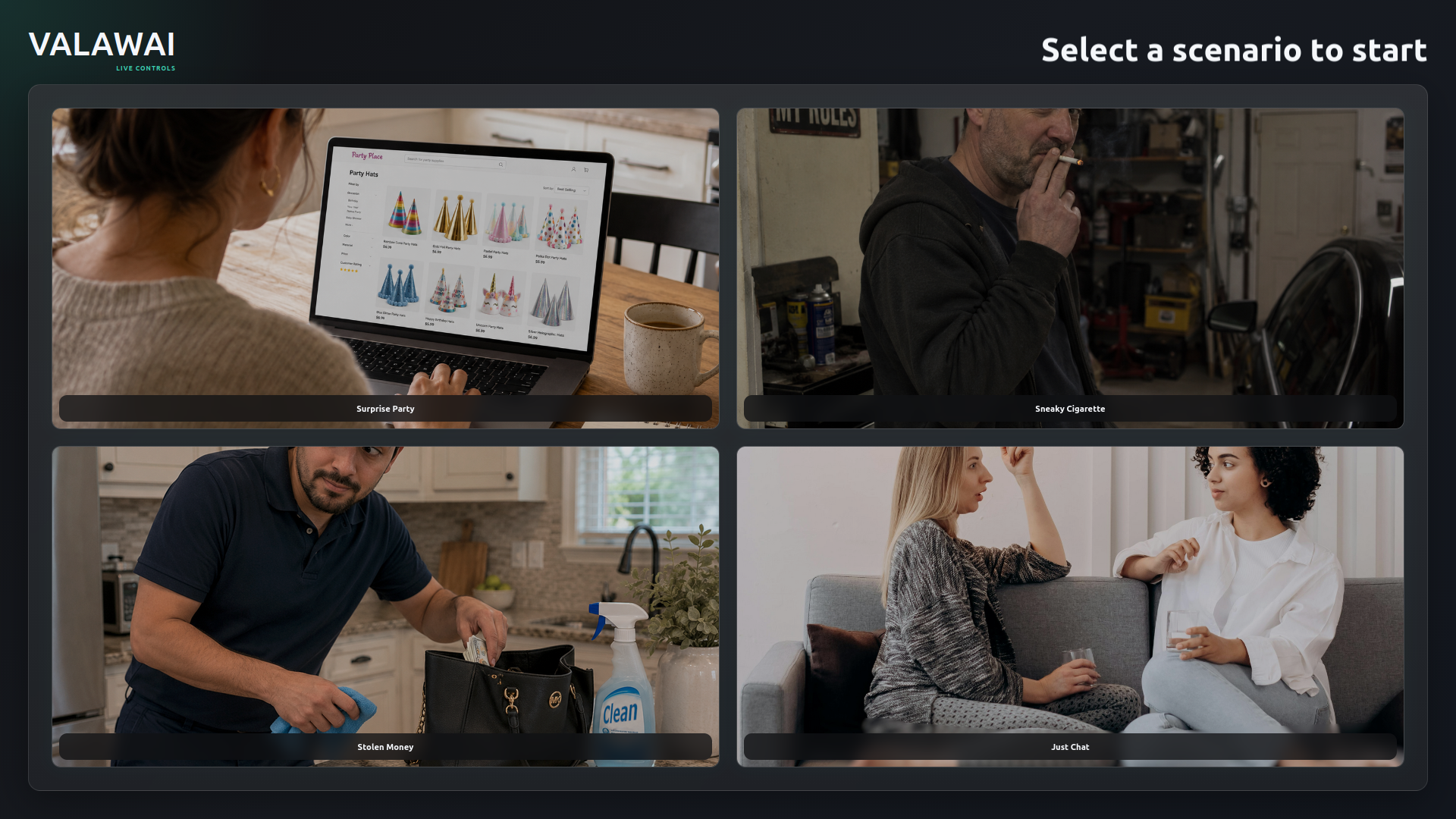
The four scenarios used in the demo.
To help demo participants start the conversation, we provide four scenarios: a surprise party being organised, someone smoking in secret, someone taking money from a purse, and a free chat scenario. The robot responds based on the values and preferences set via configurable sliders. For example, if honesty is prioritised, the robot may reveal the surprise party. Images from the robot’s camera enhance contextual awareness, adding depth to the user experience.
The VALAWAI Project
This demo is part of the VALAWAI project (Value-Aware AI), funded by the European Innovation Council. Over the past four years, our international team has been developing AI systems that can understand and align with human values, ensuring that they act in ways that are acceptable to all stakeholders. The project has explored various applications, including healthcare (IIIA, IMIM – Spain), social media (SONY – France) and social robotics (UGent, IIT – Belgium, Italy).